
Which Early Warning Indicators Should Business Continuity Disaster Consultants Monitor?

Business continuity disaster consultants should watch five kinds of warning signs: cyber activity, weather and physical hazards, supplier health, staff readiness, and the condition of the continuity plan itself. Most disruptions don’t come out of nowhere. They build slowly through small changes that are easy to wave off. Catch them early, and you can act while your options are still cheap.
That’s the work Business Contingency Group does, turning faint signals into plans that hold up under pressure. Here’s what’s ahead: why early warning matters, which signals to track, how your plan fits in, and how to act on alerts.
Why Early Warning Beats a Fast Recovery
Everyone loves a comeback, but what about the early warnings we ignore? Everbridge’s 2026 Global Risk and Resilience Outlook reveals compounding crises, with 24% of companies never testing continuity plans and 69% of incidents tied to climate.
For business continuity and emergency management, that gap should sting a little. Risk is surging, but real oversight remains dangerously low. Meanwhile, WTW found formal continuity plans in food and agriculture hit 83%, yet leader confidence keeps dropping. Plans on paper mean little without regular testing and real control.
Cyber Warning Signs Usually Show Up First
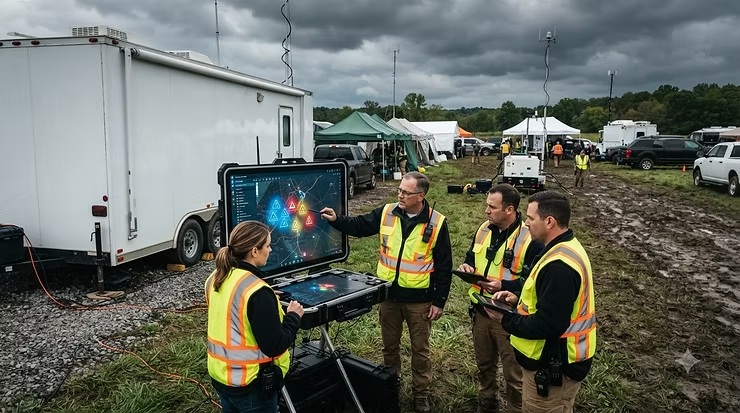
Cyberattacks rank as the top organizational risk again in 2026, and even a few hours of downtime can seriously hurt operations. So this is where most watch lists should begin.
Odd login activity
A burst of failed sign-ins, or an admin account waking up at 3 a.m., often comes before ransomware. Set alerts so a real person looks at it quickly.
Vendor security notices
When a software maker reports a flaw in something you run, find out within hours which systems are exposed. Waiting for the next patch cycle is too slow.
Backups that restore slower each quarter
That’s a sign your recovery setup is wearing down. Tell leadership now, before a real outage proves it for you.
Apps and devices nobody approved
If a tool isn’t in the inventory, it won’t be in the recovery order either. Every stray app widens the gap between what leaders think is covered and what actually is.
Patch backlogs
Systems that wait months for updates raise the odds of a breach and make recovery messier. Treat that pile as a continuity problem, not just an IT chore.
Supplier Warning Signs Show Trouble Outside Your Walls
A supplier that stumbles can stop your output faster than any local event. Give vendor health the same dashboard space as your own systems.
Money trouble
The service problem comes last; the most common causes are credit downgrades, late payments to subcontractors, or a sudden change in leadership. Get them at a young age; you still have time to find an alternative source of power.
One provider, one port, one carrier
If a process leans on a single source, flag it and push back. That kind of concentration turns a small vendor hiccup into a company-wide outage.
Missed service levels, again and again
One late delivery is noise. A string of them over a quarter points to a supplier under strain, and the pattern only shows up if you track it.
Changes in trade and in regional distribution
The shipping lanes can shift quickly – due to tariffs, sanctions, and wars. By watching them, you can make stock and sourcing changes in advance of conditions reaching your floor.
Third-party security trouble
Suppliers are required to report any breach of security or loss of security certification, and your data could be exposed if they do so. Do not underestimate the significance of their negative information as you would do with your warnings.
Your Own Plan Sends Warning Signs Too
Ask what the components of a business continuity plan are, and you’ll usually hear five answers: a business impact analysis, recovery strategies, a response structure, communication protocols, and a testing schedule. Each one waves a flag when it starts to slip.
·A stale impact analysis
If priorities or recovery time objectives have changed since the last review, the plan may protect yesterday’s operation. Flag anything that’s gone out of date.
Recovery options nobody has tried
Backup sites, spare gear, and cross-trained staff only help if they’ve been tested. A failed or skipped drill says the assumptions need another look.
Empty seats in response roles
A vacant incident commander or recovery coordinator job leaves a hole. Track staffing changes and training completion so the team stays credible when it counts.
Contact lists that fail a test call
Wrong numbers and outdated groups mean instructions won’t reach the right people. Most teams only learn this at the worst possible moment.
Drills that quietly get canceled
Roughly one in four organizations never tests its plans, so a postponed tabletop is one of the clearest signs a program is losing steam.
Turning Warnings into Action

The warning that no one is responsible for putting up is only a number on a screen. That's where the experienced business continuity disaster consultants come in. They translate raw alerts and take action for leaders to take. A basic routine looks like this:
1. Assign an owner to each indicator.
2. Determine thresholds that are consistent with the risk that a company takes.
3. Assign every alert to a well-defined escalation process.
4. Check monthly, test quarterly, and debrief after each actual event.
When alerts, updates, and tasks start to pile up, small teams can begin with a shared spreadsheet and transition to a business continuity software for small businesses. Horizon scanning is also helpful, plus monitoring X, Facebook, and LinkedIn for early signs of risks. Pick the tool you’ll actually use. The habit matters more than the software.
Final Words
So which signals deserve your attention? Cyber activity, physical hazards, supplier health, plan readiness, and the people behind the plan. Watch them steadily, give each one an owner, and test what you find. Then you’ll act while you still have choices.
If you want a second set of eyes, Business Contingency Group has helped governments and businesses prepare, respond, and recover since 2002. Our business continuity disaster consultants can build a monitoring routine around your operations. Call us and let’s talk it through!
FAQ
Q1. Which early warning signs should any small firm watch first?
Start with cyber alerts, supplier health, weather exposure, staffing gaps, and untested plans. Those five show where trouble begins and how far it can spread.
Q2. How often should business continuity indicators be reviewed?
Review fast-moving signals like cyber alerts and supplier health every month. Check slower ones, such as weather exposure and plan testing, each quarter and after any real incident.
Q3. Is cyber risk the biggest threat to business continuity now?
Surveys rank it first for 2026, but weather events and supplier failures can halt operations just as fast. Track all three side by side instead of picking one.
Q4. Why do consultants track early warning signals so carefully?
Signals expose weak spots before they turn into outages. Consultants read them, set alert thresholds, and tie each one to a recovery priority so leaders can act early.
Q5. How can small businesses begin monitoring on a tight budget?
Pick your most critical processes and track three or four indicators in a shared spreadsheet. Review it weekly, then move to dedicated software as your needs grow.



Comments