
Business Continuity Planning Services: What to Include, Test and Update

"Nobody plans to fail. Plenty of people just never test the plan." As this quote suggests, good business continuity planning services help you figure out which parts of your business can't stop. It helps you decide how fast they need to come back, test that plan, and keep it fresh as things change. Business Contingency Group (BCG) does exactly this and has been at it for over 20 years with public and private organizations. A plan that sits in a drawer won't help you when something goes wrong.
So, in this post, we'll cover what your plan needs, why a disaster recovery consultant helps, how to test it, how to train your people, and when to update it.
What Is Business Continuity and Disaster Recovery?
It's really quite simple. Business Continuity asks: How do we continue to do our business? Disaster recovery asks, "How do we recover our systems? Continuity helps maintain your critical functions before and after disruption. With Recovery, you restore your technology, data, and applications. Having disaster recovery and business continuity plans -- the two of them -- means your people, buildings, tech, and outside vendors are in the same plan, not four separate plans in four different binders that don't communicate with each other.
The one-line: Continuity keeps you going! Recovery is about getting back.
Hence, businesses need to consider them as a program rather than two separate ones when using the best business continuity planning service. It all begins with one question: "What can't we let stop?
What Should Be Included in a Business Continuity Plan?
A good plan is short enough to read in a crisis but detailed enough to actually guide you. Here's what should go in it:
Business impact analysis (BIA)
Look at the threats to your critical processes and rank them. That way you know which functions need to come back first and which ones can wait a bit.
Recovery objectives
Set a recovery time objective (RTO) and a recovery point objective (RPO) for every system. In plain terms, that's how fast you need it back and how much lost data you can live with.
Recovery strategies
Plan separately for technology, facilities, workforce, and third-party failures. Each one breaks in its own way, so each one needs its own backup plan.
Emergency response and incident management
Write down who declares an incident, who takes charge, and how evacuation, shelter-in-place, and the Incident Command System (ICS) work in those first few hours.
Communication and roles
Keep contact lists, decision-makers, and ready messages for staff, customers, and partners. Nobody should be waiting on permission while the clock keeps ticking.
Why Contingency Planning for Business Continuity Starts with a Disaster Recovery Consultant
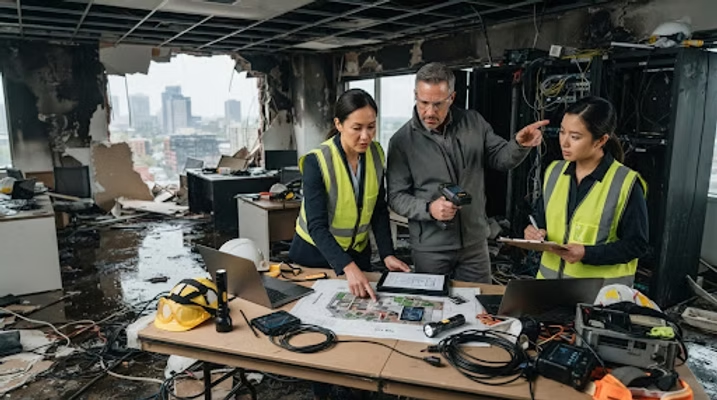
Writing each piece is one thing. Making them work together is another. A disaster recovery consultant gives you a fresh set of eyes, catches gaps your own team may miss, and keeps the plan in line with recognized professional practices. Good contingency planning for business continuity also looks at risk and vulnerability, so you prepare for the threats you really face.
BCG has worked with the United States Southern Command, the Federal Railroad Administration, RAND Corporation, Samsung, Maersk Line, Limited, and St. Joseph Health System, both in the U.S. and abroad. That mix matters. A shipping line, a health system, and an electronics company don't fail the same way.
A plan built for someone else's risks won't protect yours. Once the plan is written, the real question is whether it works.
How to Test Your Plan Before a Crisis Does
A plan you haven't tested is just a guess. Exercises check your plans and give your team a chance to practice, both big-picture and hands-on. You have a few options:
Workshops - Get your leaders in one room to walk through assumptions, roles, and gaps. Write down every action item so nothing gets lost afterward.
Tabletop exercises (TTX) - Talk through a realistic scenario around a table. Pay attention to where decisions stall, where information is missing, and where two teams think the same job belongs to them.
Functional exercises - Put a specific function to work, like your emergency operations center or IT recovery team, and see whether your procedures and tools hold up under real-time pressure.
Drills - Practice short, focused actions like evacuations, notification checks, or failover steps again and again, until people respond without stopping to think.
Training and exercises can also be delivered virtually, which is handy when your team is spread out.
Business Continuity Training for Employees Makes the Plan Real
Exercises show you what breaks. Training helps fix it. Business continuity training for employees teaches people their exact role before anything goes wrong. BCG's programs include Incident Command System training, emergency response team training, recovery and continuity awareness, e-learning courses, and live Active Shooter workshops built around Run, Hide, and Fight.
Trust plays a part too. An OSHA fact sheet that BCG points to says workers who believe their employer provides a safe workplace are more likely to show up during a pandemic, and clear communication helps build that belief. For outbreaks, BCG offers virtual Restarting Operations workshops that cover people, facilities, communications, and logistics, along with its SafetyCount Pandemic screening app.

How to Keep Your Plan Current
Plans go stale without anyone noticing. People leave, vendors change, and systems move. So make updates a habit instead of a reaction. Revisit your plan when any of these happen:
After every exercise
Turn what you learned into fixes with a named owner and a deadline. Then check in the next test that the fixes worked, instead of just assuming they did.
After a real incident
Hold a review while everyone still remembers what happened. Note what worked, then fix the procedures, contacts, and recovery targets that fell short.
When your business changes
New locations, systems, vendors, or leaders all change your risks. Update your impact analysis and recovery priorities so they match how you actually operate today.
When threats shift
Pandemics, cyber events, and severe weather each call for a different response. Review your risk assessment often and add scenarios that weren't on your radar before.
On a fixed schedule
Review contacts, roles, and dependencies once a year. Business continuity software can also help you track plan status and versions in one place.
BCG's software support covers continuity of operations, disaster recovery, risk, BIA, incident response, and notifications.
Final Thoughts:
A dependable plan does three things. It names what matters, proves itself in testing, and changes when your business does. Build it in that order, train your people, and check back often. If you'd like experienced help, Business Contingency Group can walk with you from the first assessment to ongoing upkeep, with business continuity planning services built around your risks. For any further details, check out our website or call (818) 784-3736. Build your backup plan before any disaster hits!
FAQs
1. What do business continuity planning services usually cover?
They cover risk assessment, business impact analysis, recovery time and recovery point objectives, communication plans, disaster recovery steps, training, and regular testing.
2. How often should a business continuity plan be fully tested?
Test at least once a year, and after any major change. Use tabletop exercises for decisions and functional or full-scale drills for teams, systems, and vendors.
3. What is the key difference between BCP and disaster recovery?
Business continuity keeps critical functions running during a disruption. Disaster recovery focuses on restoring IT systems and data afterward. Both work best as one plan.
4. Why is business continuity training for employees important?
Trained employees know their roles, follow the plan under stress, and communicate clearly. Training turns a written document into fast, confident action.
5. When should a business continuity plan be updated or revised?
Update after every exercise, major incident, or business change, such as new systems, vendors, locations, or staff. Also review the full plan at least once a year.


Comments