
Mastering Disruption: A Strategic Blueprint for Business Continuity Planning Solutions

Operational shocks almost never give a warning. A sudden cyber intrusion, a massive server farm going dark, a regional power blackout or a critical supplier folding overnight — these events freeze an entire enterprise in mere minutes. Companies surviving these disasters without permanent financial scars do not depend on luck. They actually make it through because their executive teams mapped out strict priorities early on. Those leaders assigned hard response roles and locked down effective business continuity planning solutions long before any alarms started ringing.
This guide breaks down the core architecture of an effective continuity plan. We look at the necessary pieces and outline a very practical development strategy.
The Growing Need for Integrating Business Continuity Planning Solutions
Building a response blueprint hands your team a highly tactical framework. Business continuity planning solutions allow your departments to keep vital operations breathing during a brutal outage and rapidly bring normal workflows back online. Proper planning cuts down on devastating downtime and shields your active revenue streams. It protects your staff — calms panicked stakeholders — and stops executive decision-making from turning into complete chaos under pressure.
Creating the actual document practically forces leadership to look hard at core dependencies and figure out acceptable downtime limits before the real panic hits.
Defining the Business Continuity Strategy
A formal business continuity plan acts as a highly documented set of operating rules. The text spells out recovery tactics, communication chains and the exact leadership roles needed to keep a company moving during a sudden shock. The objective is not trying to block every possible incident from happening. The actual goal is guaranteeing the enterprise keeps functioning after a critical failure inevitably hits.
Organizations exploring business continuity planning solutions usually need answers to several heavy operational questions:
What exact scenarios count as a severe business disruption?
Which corporate functions absolutely must stay active to dodge insolvency?
How fast do we have to recover our data and systems?
Who actually commands the crisis response?
Which third-party vendors and supply chains do we lean on the hardest?
Many leaders get business continuity mixed up with disaster recovery. A disaster recovery plan strictly targets restoring IT hardware — fixing broken servers and recovering wiped data after a breach. A wider continuity plan tackles the entire organizational ecosystem - it manages the human workers, stabilizes customer service channels, patches up broken supply chains, secures physical buildings and keeps vendor relationships intact
The Financial and Operational ROI of Preparedness

The absolute necessity of elite crisis management turns painfully obvious when the second critical infrastructure snaps.
Without a plan in place, internal teams end up improvising their entire response. Executive leadership gets dragged into tiny tactical arguments instead of focusing on the big strategic recovery. Staff members end up duplicating the exact same tasks or just sit idle waiting for someone to give an order. Customers get conflicting updates. Recovery timelines stretch out dangerously long simply because nobody established what matters most beforehand.
Armed with a solid plan, an enterprise navigates the mess with speed and sharp precision. Critical systems shift over to fallback protocols instantly. Teams understand their exact escalation paths without asking questions. Public communications are drafted early and legally reviewed — rather than hastily typed out during a total panic. Leadership focuses entirely on minimizing the broad business fallout instead of rushing around trying to fix basic technical glitches.
Did You Know - Data points out that nearly 40 percent of small to mid-sized enterprises never reopen their doors following a severe disaster — and another 25 percent fail within one single year.
Organizations operating without documented business continuity planning solutions often burn the critical first 48 hours of an emergency fighting over who has financial authority instead of actually executing a recovery.
The Core Architecture: What Belongs in Your Blueprint?
1. The Business Impact Analysis (BIA)
The BIA acts as the absolute bedrock of your strategy. The analytical process identifies your most critical business functions and measures exactly how long they can sit offline. The analysis maps out deep operational dependencies and highlights the exact financial damage assuming those specific functions stay unavailable.
Figuring out your hourly financial burn rate during a server outage forces executives to take the planning phase seriously.
2. Viable Recovery Strategies
You must define exactly how your most valuable operations will survive a disruption once you identify them. Viable recovery strategies often mean activating remote work protocols or shifting back to manual analog workflows. They might involve spinning up backup cloud environments or triggering secondary vendor contracts immediately.
3. Crisis Communication Frameworks
A major disruption is fundamentally a giant communication event. Your strategy must define who manages the internal staff updates and who talks publicly to external stakeholders. The framework has to establish alternative communication channels assuming your primary corporate networks go completely dark.
4. Absolute Role Clarity
Ambiguity destroys response times. The continuity document must explicitly name the incident commander, the technical responders, the department leads and the communication liaisons. You must designate a fully trained backup for every primary role just in case key personnel are unreachable.
Designing Your Business Continuity Plan: A Step-by-Step Approach
Developing functional business continuity planning solutions does not require writing an overwhelming thousand-page manual. The process demands disciplined and methodical focus.
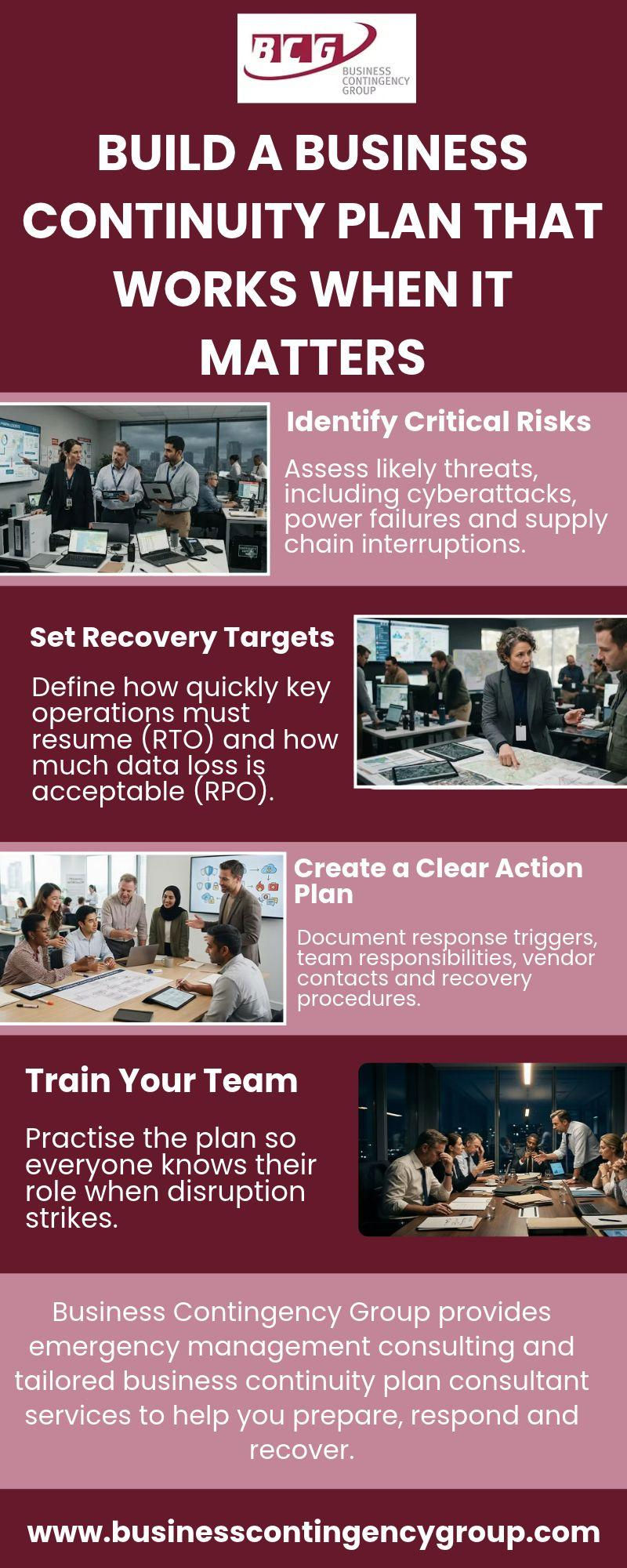
Step 1: Execute a Focused Risk Assessment - Pinpoint the disruption scenarios most likely to hit your specific industry and geographic region. Look hard at cyber threats, localized power grid failures and massive supply chain blocks.
Step 2: Determine RTO and RPO Metrics - Establish a Recovery Time Objective (RTO) for every single critical function. The metric dictates how quickly the process must turn back on. Pair the number with a Recovery Point Objective (RPO) — the absolute maximum amount of acceptable data loss quantified in hours or minutes.
Step 3: Draft an Actionable Document - Keep the final document highly structured and easy to scan. Include specific incident triggers, role assignments, vendor contact sheets and step-by-step recovery procedures.
Step 4: Prioritize Staff Training - A plan that exists only on paper offers zero real protection. Staff must understand exactly when the plan activates and what their specific duties entail.
The Testing Imperative: Escaping the Set-and-Forget Trap
Drafting a plan is only the starting line. Testing is what separates theoretical ideas from usable operational frameworks.
The most efficient testing method is a tabletop exercise. Executive leaders and department heads sit down and verbally walk through a hypothetical disruption scenario. They discuss their required decisions and pinpoint exactly where the documented plan falls apart.
Quick Tip - Organizations should run these exercises at least annually — or immediately following major technology migrations, office relocations or big vendor changes.
Moving beyond tabletop exercises means running full-scale simulation drills. A full drill forces employees to actually evacuate buildings or connect to backup servers in real time. Meticulously measure how quickly the incident was identified during these live tests.
Check that alternative communication channels functioned properly. Verify that your estimated recovery timelines actually matched reality.
Overcoming Common Business Continuity Planning Failures
Many organizations hold a continuity plan that is functionally useless. The binder usually sits outdated, untested or insanely complicated.
Treating continuity planning as a one-time compliance chore is a massive error. Your documented strategies must adapt alongside new software deployments and vendor agreements as your business evolves. Failing to test the plan is equally toxic. Untested strategies usually rely on obsolete contact lists and highly unrealistic recovery assumptions.
Concentrating exclusively on IT recovery leaves the entire enterprise wide open to massive communication breakdowns and supply chain collapses. Another fatal mistake involves keeping the only copy of the continuity plan stored on the exact same servers that just crashed. Hard copies and secure off-site cloud access are absolutely non-negotiable.
Key Takeaways
Business continuity planning solutions help organisations maintain critical operations, reduce downtime and recover faster from unexpected disruptions.
A Business Impact Analysis (BIA) identifies essential business functions, operational dependencies and the financial risks of prolonged downtime.
A strong business continuity plan includes practical recovery strategies, clear employee responsibilities, crisis communication procedures and backup systems.
Risk assessments and recovery objectives help businesses identify potential threats and establish acceptable recovery times and data loss limits.
Regular testing and employee training keep continuity plans effective. Tabletop exercises and simulation drills help identify weaknesses before a real crisis occurs.
Working with experienced continuity planning consultants helps organisations develop customised strategies, address planning gaps and improve their ability to respond to emergencies.
Partner with the Business Contingency Group
Building, testing and maintaining elite business continuity planning demands deep specialization. Partnering with experienced professionals delivers the ultimate competitive edge during times that demand guaranteed operational resilience.
Founded in 2002, Business Contingency Group delivers top-tier emergency management consulting and full-scale disaster management consultancy to public agencies and corporate enterprises alike.
As leading experts in Humanitarian Assistance in disaster management, our certified advisors firmly reject generic templates. We deliver customized business continuity plan consultant services built to match your exact organizational objectives. Aligning with proven specialists secures the insight and strategic frameworks you need to protect your personnel, preserve your revenue and guarantee survival.
Contact Business Contingency Group today and construct an operational shield built to survive the unexpected!
Frequently Asked Questions (FAQs) About Business Continuity Planning Solutions
1) What are business continuity planning solutions?
They are structured and proactive frameworks designed to help an organization maintain critical workflows and quickly recover following an unexpected disruption.
2) How does a continuity plan differ from a disaster recovery plan?
Disaster recovery focuses primarily on restoring IT infrastructure and databases — whereas a continuity plan encompasses the entire organization including personnel, facilities and communications.
3) What is a Business Impact Analysis (BIA)?
A BIA is a diagnostic process that identifies an organization's most critical business functions and evaluates the harsh financial costs associated with their interruption.
4) How often should an enterprise update its continuity plan?
Organizations must review their continuity plans annually or immediately following significant operational changes like staff turnover, office relocations or major software migrations.
5) Why are tabletop exercises vital for executive teams?
Tabletop exercises allow leadership to verbally simulate real-world emergency responses. The practice identifies operational roadblocks and builds team confidence without risking live business functions.



Comments