
The First 60 Minutes of a Crisis: Where Operational Resilience Planning Makes the Difference

As soon as a core system goes out of service the clock begins. Pagers go off. Confused messages are posted on chat channels. The first hour determines whether it is a quick fix or a full-on paralysis. That's why operational resilience planning comes in handy and helps to staunch the bleeding. It eliminates all that frantic scrambling and makes it a disciplined step-by-step response because minutes pass quickly when there's no one to know who is operating the bridge call and who has the backup keys.
Heating up the situation by waiting for committee agreement while an outage is underway only exacerbates the problem. It's a money and trust destroyer that strikes quickly. In the current risk environment, we need to act now before all the facts are in. Don't bother with a management debate next Tuesday when a broken server needs to be contained now. So, we're going to look at the exact sequence of events with early crisis triage, modern automatic defense mechanisms and what actions you can take to keep your critical assets safe when you suddenly find yourself in a collapse of operations.
The Brutal Reality of the First Hour
When infrastructure drops offline unexpectedly, initial information is almost always fundamentally wrong. The engineering team might suspect a routine network timeout. Support staff get buried under cancellation tickets. Executives demand certainty that simply does not exist yet.
The thing is, waiting around for total clarity is a fatal mistake. Every passing minute gives an incident deeper roots into the enterprise ecosystem.
Did you know? Taking more than 45 minutes to contain a sudden network outage can easily quadruple your legal fines and customer churn rates compared to faster industry competitors.
Triage heavily beats precision early on - Stabilizing the perimeter matters far more than drafting a flawless post-mortem while servers are actively burning.
Silence breeds disastrous speculation - Employees and board members fill internal information vacuums with worst-case assumptions every single time.
Containment strictly precedes diagnosis - Pulling the plug on an infected network segment hurts. But letting an infection move laterally across production databases hurts infinitely worse.
Anchoring Crisis Management Planning in Reality
Most response strategies gather dust on shared network drives.- mostly because they are written for compliance auditors rather than actual ground operators.
Effective crisis management planning must function just like an aviation checklist. Direct. Unambiguous. Completely practical under extreme cognitive overload.
Single-threaded command models save time - Committee leadership during a disruption fails completely. One designated incident commander must hold absolute operational veto power.
Predetermined escalation thresholds remove hesitation - Hard metrics must dictate when an issue moves from tier-one support straight to executive leadership. Zero intermediate meetings required.
Segregated communication lines keep teams connected - If corporate email goes down with the infrastructure, teams need pre-configured out-of-band paths ready instantly.
Here's why that matters. When a disruption accelerates, cognitive tunnel vision degrades human decision-making fast. Responders need structured guidance. Implementing real-time operational telemetry gives responders unfiltered visibility into system health. It strips emotional guesswork completely out of the equation.
The 60-Minute Rapid Response Playbook
When an operational failure strikes, execution discipline dictates survival. Use this chronological checklist to control the narrative and stabilize operations during that critical first hour.
Minutes 0–10 - Triage & Incident Command Activation
Log the initial alert timestamp.
Confirm the trigger validity across independent monitoring nodes.
Designate the incident commander immediately and hand over absolute tactical coordination authority.
Open an isolated communication channel dedicated exclusively to active response personnel.
Minutes 10–20 - Isolation and Blast Radius Containment
Cut suspected communication pathways between compromised segments and clean production environments.
Trigger automated traffic re-routing policies to spin up redundant warm standby infrastructure.
Deploy autonomous incident response scripts to freeze altered system permissions across all directory tiers instantly.
Minutes 20–40 - Evidence Verification and Impact Mapping
Separate hard technical log data from observational assumptions provided by upset end users.
Cross-reference impacted assets against primary dependency maps.
Identify downstream vulnerabilities quickly.
Draft verified internal holding statements so staff do not spread inaccurate rumors to external clients.
Minutes 40–60 - Stakeholder Alignment & Tactical Handoff
Brief senior leadership with documented technical facts.
Present the containment status and calculated recovery timelines.
Release the first standardized customer advisory confirming acknowledgment and remediation efforts.
Transfer sustained operational troubleshooting over to dedicated disaster recovery teams.
Where AI Business Continuity Management Changes the Game
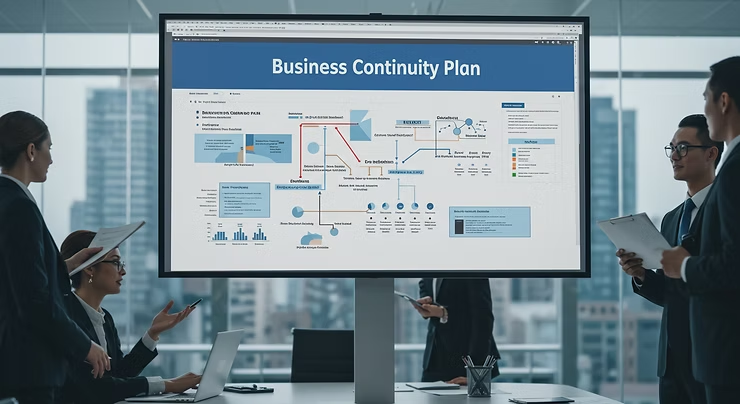
Human beings are incredibly slow at parsing millions of correlated log lines across distributed cloud environments. A person checks dashboards sequentially. They miss patterns hidden across completely separate database clusters.
That is why AI business continuity management has evolved from an experimental tech luxury into a strict operational baseline. Machine learning architectures do not sleep. They do not panic. And they never get overwhelmed by alert fatigue.
Micro-anomaly detection spots trouble early - Algorithms flag irregular system behavior weeks before an actual infrastructure collapse takes place.
Self-healing failovers bypass human lag - Modern configurations detect hardware degraded states and route workloads elsewhere without engineers clicking a single button.
Dynamic resource allocation keeps critical functions alive - AI identifies operational choke points and scales auxiliary computing capacity directly to unaffected zones.
Plus, by using generative AI disaster recovery engines, companies can generate tailored containment scripts and regulatory notifications on the fly. That entirely eliminates manual drafting delays. It gives technical teams their time back to fix broken code.
Making Operational Resilience Planning Work on the Ground
Theoretical risk registers look great in executive slide decks. But they offer exactly zero utility during a midnight server failure. Genuine resilience requires operational frameworks built for messy, high-pressure environments.
And that means identifying which processes generate revenue- which keep operations legally compliant. And which can sit dormant for three days without killing the brand.
Rigid dependency tracking prevents blind spots - Software platforms depend on third-party APIs, authentication providers, and specific personnel. Knowing these choke points beforehand prevents massive surprises.
Stated impact thresholds define urgency - Establish exactly how many hours of downtime an e-commerce checkout can sustain before permanent financial damage occurs.
Predictive intelligence maps the domino effect - Feeding historical system behavior into predictive threat modeling engines anticipates cascaded infrastructure failures before alerts even fire.
Teams that document these variables ahead of time do not waste thirty minutes figuring out who needs to approve a cloud provider failover. The operational authority is already fully delegated. Engineers can make protective calls without waiting for corporate legal counsel to wake up.
Evolving Business Continuity Strategies for 2026 & Beyond
The threat environment moves infinitely faster than regulatory policy cycles. Designing resilient architectures means leaving behind rigid disaster recovery models. It requires adopting agile business continuity strategies for 2026 built entirely around continuous adaptation.
Annual disaster drills just do not cut it anymore.
Continuous posture testing breaks things on purpose - Leading teams use continuous fault injection to break things intentionally in staging environments.
Vendor risk transparency closes backdoors - Software supply chains introduce massive secondary attack surfaces that must be scrutinized continuously.
Regulatory alignment prevents massive fines - Financial and healthcare regulators increasingly audit whether institutions can withstand sustained outages without causing public disruption.
The thing is, legacy compliance frameworks only deal with yesterday. Continuity protocols are continuously adapted to current threats through dynamic risk mapping, in line with current models of defense. When proactive defense measures are built into routine code releases, companies are entirely out of the negative morning headlines.
Focused Business Continuity Planning for SMEs Today
Mid-sized businesses face an incredibly steep uphill battle. They face the exact same digital adversaries and supply chain headaches as massive global corporations. Yet they have to fight them without deep balance sheets or sprawling internal security operations centers.
That harsh reality makes focused business continuity planning for SMEs a matter of raw survival. A bad week for a massive corporation is a blip. For a small business, it can be totally fatal.
SaaS and cloud reliance levels the field - Small teams should bypass costly physical infrastructure in favor of turnkey cloud architectures with built-in regional redundancy.
Eliminating single points of failure stops bottlenecks - If one system administrator holds the master encryption keys in their head, the company is one missed phone call away from catastrophe.
Managed defense partners provide scale - Retaining external incident response firms gives companies access to high-end tools without supporting six-figure specialized salaries.
A significant database corruption can easily push an undercapitalized business into sudden liquidation. Lean, highly disciplined preparation levels the playing field completely.
Building Real Muscle Memory

A response plan existing only on a laminated document is completely useless when servers lock up. The best technical designs fail instantly if staff panic the moment alarms trip.
You cannot expect flawless execution without rigorous, uncomfortable practice.
Unannounced scenario walkthroughs expose the truth - Testing how staff handle unexpected data losses reveals systemic organizational flaws far better than planned, comfortable reviews.
Blameless post-mortems fix the process - Analyzing why an outage occurred without looking for someone to fire leads to honest reporting and better process engineering.
Continuous playbook updates keep tactics fresh - Every security patch, staffing change, or SaaS migration requires a corresponding adjustment to the emergency handbook.
Companies continuously refining their operational resilience planning build deep, institutional muscle memory. When an emergency happens, people do not stop to wonder what their responsibilities are. They just blindly execute the drill.
Key Takeaways
The opening 60 minutes of a business crisis directly dictate downstream regulatory fines and brand trust.
Decentralized, ambiguous decision-making during an active incident worsens downtime exponentially.
Automated telemetry and algorithmic triage isolate infrastructure compromises significantly faster than manual human reviews.
Mapping cross-platform dependencies prevents secondary cascading failures throughout extended vendor networks.
Consistent scenario testing builds the institutional muscle memory required to maintain stability under extreme stress.
Final Words
The first hour of any downtime is unruly, grueling, and deeply confusing. It's also the best time of all to demonstrate structural competence. Organizations that have replaced scrambles with playbooks driven by data and information become existential threats to the minor, manageable outages. Proper operational resilience planning is an investment you can make in a business early to ensure that in the event of the worst case scenario, the business retains control of its data, reputation and future.
Looking to defend your business' core activities from unforeseen system failures? Call the Business Contingency Group today to make sure your business keeps running in times of crisis!
FAQs About Operational Resilience Planning
What is operational resilience?
It is a company's capacity to anticipate, absorb, adapt to, and recover from severe operational shocks while continuing to deliver essential services without catastrophic financial damage.
How does resilience differ from crisis management?
Resilience focuses on proactive architectural design allowing systems to endure disruptions. Crisis management governs the tactical human execution and communication protocols deployed after an incident occurs.
Why is the first hour of a crisis so critical?
Containment success hinges entirely on early triage. Actions taken within the first 60 minutes prevent widespread operational contamination, reduce business interruption costs, and curb damaging public speculation.
How does AI improve business continuity?
AI processes security alerts instantaneously. It isolates compromised digital infrastructure autonomously and orchestrates failover routines long before human incident responders can manually review complex technical logs.
What are the core steps of a continuity plan?
A functional plan maps organizational dependencies, defines acceptable downtime thresholds, establishes incident command structures, deploys automated containment workflows, and tests response protocols through realistic scenario drills.



Comments