
Business Continuity Plan vs Contingency Plan: Why Most Organizations Need Both

The first instinct when something goes wrong isn't just "what do we do now,"; it's "which plan are we even supposed to follow." That mix-up can end up costing more time and money than the actual disaster. A lot of people use continuity and contingency planning as if they mean the same thing, but they don't, and the difference (business continuity plan vs contingency plan) matters a great deal in business continuity and emergency management.
At Business Contingency Group, we have seen this play out again and again, and our experience shows these two plans aren't rivals; they're teammates.
So let's walk through what actually separates them, how they work together when things go sideways, and why leaning on just one of them leaves you exposed.
Brief Overview of Business Continuity Plan vs Contingency Plan
Put simply, a business continuity plan is your roadmap for keeping the lights on, in every sense, while your organization works through a disruption.
Keeps an eye on long-term stability, not just the first 24 hours
Touches your people, your processes, your tech, and your buildings
Points out which functions absolutely cannot go down
Helps you plan out recovery timing and where resources should go
Sits at the center of any solid business continuity planning effort
A contingency plan, on the other hand, is your quick-reaction guide for one specific type of emergency.
Built around one clear threat, like a fire or a server crash
Tells staff exactly what to do, step by step, no guesswork
Kicks in fast, the moment an incident is confirmed.
Zeroes in on getting the immediate danger under control
Fits inside a bigger preparedness picture rather than standing alone
Business Continuity Plan vs Contingency Plan: Key Differences
Aspect | Business Continuity Plan | Contingency Plan |
Purpose | Maintains overall business operations | Responds to a specific incident |
Scope | Organization-wide | Incident-specific |
Timeframe | Short-term through long-term recovery | Immediate response |
Focus | Continuity of critical functions | Managing the crisis at hand |
Trigger | Any disruption affecting operations | A defined emergency scenario |
Owner | Business continuity and executive leadership | Department or incident response teams |
They are complementary, not competing, plans. Neither one does much good on its own, but put them together, and you get a real, workable approach to staying resilient.
How Business Continuity and Contingency Plans Work Together
In practice, these two plans don't sit on a shelf waiting their turn; they move together, one after the other, during a real event. Think of it this way: one deals with the fire, the other keeps the rest of the house running.
Incident occurs - something unexpected hits, and normal business grinds to a halt without any warning at all.
Contingency Plan manages the emergency - the team follows the pre-set steps to get the immediate danger under control fast.
Business Continuity Plan keeps operations running - backup processes and resources step in so critical work doesn't stop cold.
Recovery and restoration begin - damaged systems, facilities, and services start getting patched up and brought back online.
Organization returns to normal operations - everyone shifts out of crisis mode and back into their regular day-to-day routine.
Real-World Examples Across Different Industries
No two industries face the same risks, which is why business continuity strategies need to be built around what actually threatens each one. Here's what this looks like when it plays out in the real world.
Healthcare: A power outage mid-treatment means backup generators kick in fast, while continuity plans keep patient care from being interrupted.
Manufacturing: When equipment breaks down and halts the line, repair crews take over as continuity plans reroute orders to limit the delay.
Government Agency: A natural disaster hits public services, emergency crews respond immediately, and continuity plans keep essential services running for residents.
Education: A cyberattack knocks online systems offline, IT jumps in to contain it, while continuity plans hold academic work together.
Corporate Office: A fire triggers an evacuation, safety protocols take over, and continuity plans help staff keep working from elsewhere.
Notice the pattern? The contingency plan deals with the incident right in front of it, while the continuity plan quietly makes sure the rest of the organization keeps moving forward.
Signs Your Organization Needs Both Plans
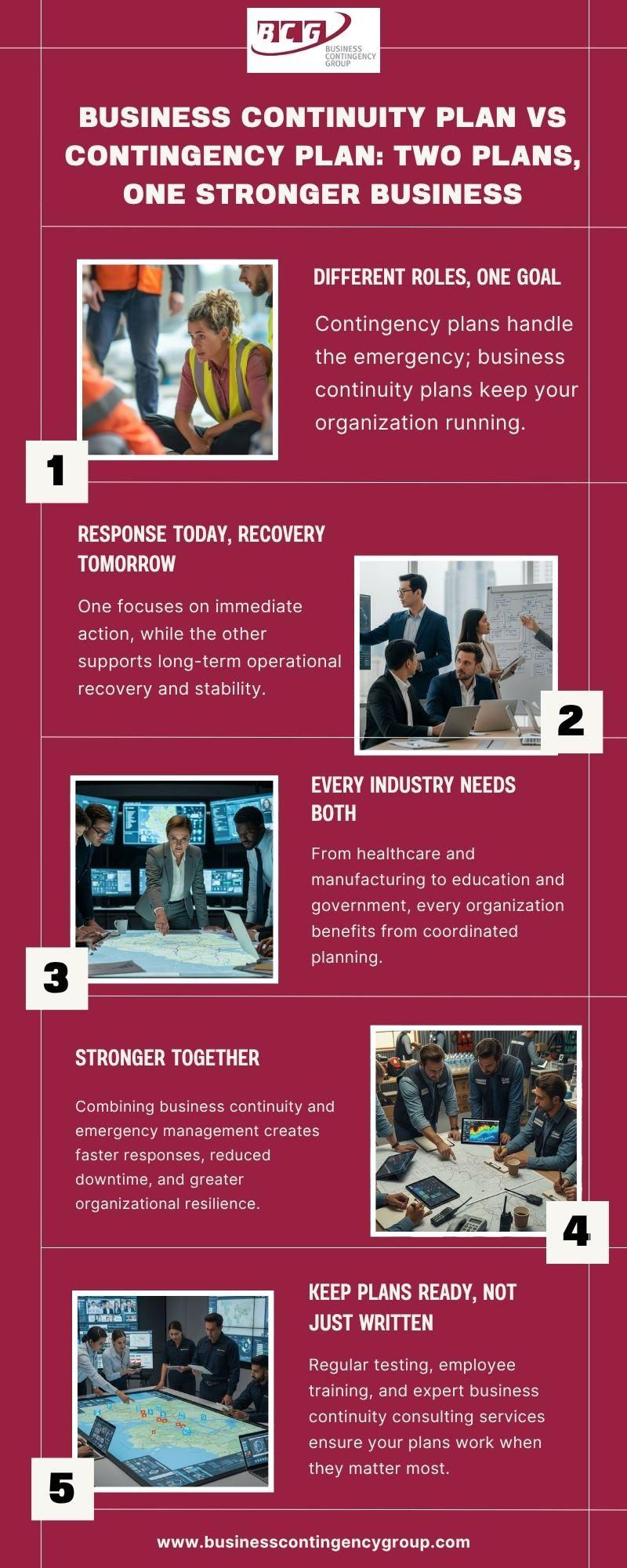
Plenty of organizations assume one plan will cover them, but certain everyday realities say otherwise. Run through this checklist and see how many apply to you.
Multiple office locations mean different risks in different places, so you need a coordinated response.
Remote workforce relies on tech staying up no matter what kind of disruption hits.
Critical IT systems going down can cause everything else to fall apart too.
Regulatory obligations mean you need documented, tested plans just to stay compliant.
Customer service commitments don't pause for emergencies, so support has to keep going.
Supply chain dependencies bring in risks that are outside your direct control.
Public safety responsibilities raise the pressure for a fast, coordinated response.
High financial impact from downtime makes getting back on your feet quickly a must.
Building a Strong Organizational Resilience Strategy
Real resilience isn't just a binder sitting on a shelf; it comes from practicing, testing, and improving over time, often with help from business continuity consulting.
Risk assessments spot the weak points
Business Impact Analysis shows what's really at stake
Emergency management planning shapes the response
Crisis management guards your reputation and people's safety
Disaster recovery planning gets systems back online
Tabletop exercises put decision-making to the test
Full-scale exercises check readiness under real pressure
Employee awareness training gives staff confidence to act
Regular plan reviews keep everything current
Put these pieces together, and you've got the backbone of solid business crisis management. Organizations that invest the time in each of these layers tend to bounce back faster and hold onto their operations even when things get rough.
How Professional Planning Improves Preparedness

Let's be honest, most internal teams don't have the time or the specialized know-how to build this out on their own, and that's exactly where bringing in outside help pays off. Good business continuity consulting services can spot the blind spots you'd otherwise miss, line your plans up with recognized standards, and turn theory into a strategy that actually works when tested. Business Contingency Group offers this kind of hands-on, practical support for organizations that want to get more coordinated and better prepared, at every level.
Bottom Line
Knowing the difference between a business continuity plan vs contingency plan isn't just a box to check; it genuinely shapes how fast and how well your organization bounces back when something goes wrong. Contingency plans handle the crisis right in front of you; continuity plans protect everything else.
Put them together, and you get a strategy sturdy enough to hold up against whatever comes next. For more information, consult the Business Contingency Group and stay prepared with the best crisis and management solutions!
FAQ Section
Q1. What is a contingency plan exactly?
It is a targeted response plan for a specific emergency or incident type.
Q2. How is continuity planning different?
Continuity planning maintains overall operations across any disruption, not just one event.
Q3. Can small businesses skip contingency plans?
No, even small businesses face risks requiring immediate, defined incident response.
Q4. How often should plans be reviewed?
Plans should be reviewed at least annually or after major changes.
Q5. Who should manage these plans internally?
A cross-functional team, often guided by continuity or risk professionals.


Comments