
Stay Up to Date with the Latest Business Continuity Strategies and Insights: BCG

Most companies figure out they need a plan right after they need one. A power cut during peak hours. A supplier disappearing overnight. A cyberattack on a Wednesday. The businesses that came through those moments were not lucky. They had thought about it beforehand.
This post is about what that thinking actually looks like, covering practical business continuity strategies, the real difference between business continuity vs disaster recovery, and what credible business continuity consulting services bring to the table.
Why Business Continuity Matters More Than Ever
No disruption announces itself. Floods, data breaches, staff walkouts, vendor failures, they arrive without scheduling. Business continuity is not pessimism. It is what separates organizations that bounce back in days from those that spend months trying to recover. The gap between the two is almost always preparation.
DID YOU KNOW?
Misinformation/disinformation, extreme weather events and cyber insecurity were among the top 10 global risks likely to impact businesses and governments over the next two years as identified by the World Economic Forum’s Global Risks Report 2025.
That is why it is now a priority for many organisations to invest in improving their business continuity strategies and crisis readiness programmes to maintain their operations in unforeseen events.
Understanding Business Continuity in Simple Terms
A lot of corporate language surrounds this topic. Here is the plain version:
Business continuity keeps your most critical work running during a disruption, not just after the mess is cleaned up.
A business continuity plan (BCP) is a practical written guide on who does what, in what order, when things break down.
Risk and vulnerability assessments find the weak points in your operations before an incident does.
Business impact analysis (BIA) tells you which functions hurt most if they go offline, so recovery targets the right things first.
A plan nobody has tested is just a document. Regular drills and honest reviews are what make it functional.
What Business Continuity Actually Means
Business continuity is keeping mission-critical operations running through any kind of disruption, short or extended, predictable or not, technical or physical.
Business Continuity vs Disaster Recovery
People conflate these two all the time. They are related but not interchangeable.
Business continuity is the full picture of how your whole organization keeps functioning across people, processes, communication, and facilities when something goes wrong.
Disaster recovery is a focused technical effort, getting your IT systems, servers, and data back online after an incident.
One is the full strategy. The other handles the technology recovery piece within it. For more information on mastering business continuity and risk management strategies, check out this post.
Difference Between Operational Continuity and Technology Recovery
Aspect | Business Continuity | Disaster Recovery |
Primary Focus | Keeping all operations running | Restoring IT systems and data |
Scope | Whole organization | Technology only |
Timeline | Before, during, and after disruption | After an incident |
Key Document | Business Continuity Plan (BCP) | Disaster Recovery Plan (DRP) |
Goal | Operational resilience | Minimum downtime and data loss |
Why Every Organisation Needs a Continuity Plan
It does not take a headline-level disaster to damage a business. One key person is out unexpectedly. A critical system is offline at the worst time. A vendor that simply stops responding. Without a plan, your team improvises under pressure. With one, they follow a process someone already thought through when the stakes were lower.
Key Strategies Businesses Should Focus on for Resilience

Five business continuity strategies that actually make a difference:
1. Emergency Preparedness and Crisis Planning: Written, practiced plans with assigned roles sorted out well before any emergency, not drafted during one.
2. Communication During Emergencies: Backup channels kept ready for when primary ones go down. Communication gaps turn manageable incidents into serious ones quickly.
3. Technology and System Readiness: Clear recovery point objectives (RPO) and recovery time objectives (RTO) take the guesswork out of what needs restoring and how fast.
4. Employee Safety and Response Procedures: Evacuation plans, shelter-in-place protocols, and trained response teams. People who know their role act faster and stay calmer.
5. Recovery and Operational Continuity: A clear sequence for bringing functions back online in the right order, without confusion or missed steps.
If you still want to explore more about Business Continuity Plan, then read this blog post with the key components of a business continuity plan.
How BCG Helps Organisations Stay Prepared
BCG has been involved in this area of research since 2002. We serve clients all over the United States and the world, such as USSOUTHCOM, Samsung, Maersk and the Federal Railroad Administration. Staff members are certified by the Disaster Recovery Institute International and the Business Continuity Institute. Since no two organizations have the same risk profile, no program is going to be exactly like the previous one.
Emergency Management Programs
Business Continuity Consulting Services
Business Impact Analysis
Technology and Software Solutions
Training and Exercises
Why Ongoing Training and Preparedness Are Essential
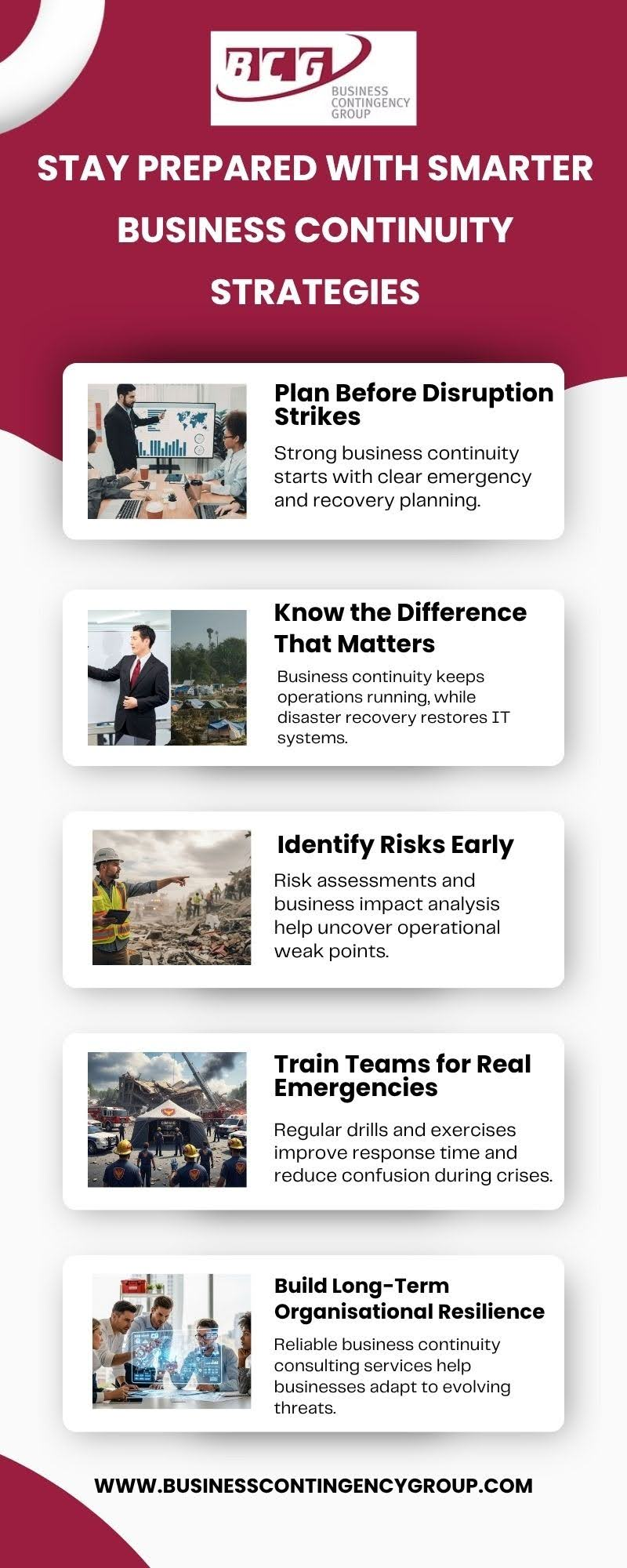
A completed plan does not equal a ready team. Organizations that handle real incidents well almost always practice first — run through scenarios, identify what fell apart in drills, and correct it before anything real is at stake. BCG builds training programs that put plans under genuine pressure and surface gaps before a real incident does.
Tabletop Exercises (TTX)
Full-Scale Exercises
E-Learning Development
Active Shooter and ICS Training
The Future of Business Continuity and Organisational Resilience
Cyber threats keep getting sharper. The weather grows less predictable. Supply chains stay fragile. The organizations handling disruptions consistently well treat business continuity as an ongoing program, something regularly updated, tested, and improved — not a binder produced once and shelved. The value of experienced business continuity consulting services and a sharp disaster recovery consultant grows alongside that complexity.
Key Takeaways:
Business continuity keeps operations running during disruptions.
Disaster recovery focuses on restoring IT systems.
Tested continuity plans improve crisis response.
Training helps teams respond faster in emergencies.
Business continuity services reduce operational risks.
Bottom line:
Good preparedness does not happen by accident. It comes from honest planning, regular practice, and working alongside people who have actually managed these situations across different industries. Getting business continuity vs disaster recovery right, putting solid business continuity strategies in place, and investing in proper business continuity consulting services are the decisions that determine whether a disruption becomes a short interruption or a long recovery.
BCG has spent over two decades helping organizations build that kind of readiness. Visit our website to find out how we can help you.
Frequently Asked Questions
Q1: What are business continuity strategies?
Practical, tested plans that keep critical operations running through a disruption, not just recovery plans for after one ends.
Q2: What does a disaster recovery consultant do?
A disaster recovery consultant plans and manages how IT systems and data are restored after a disaster, keeping downtime short and data loss minimal.
Q3: How do business continuity services help organizations?
Business continuity services prepare organizations before disruptions arrive, guide response when they do, and prevent recovery from dragging on longer than it needs to.
Q4: What separates business continuity from disaster recovery?
Business continuity covers the full organization across all functions. Disaster recovery focuses on restoring technology after an incident. One is the complete plan; the other is an important part of it.
Q5: Why are business continuity consulting services worth the investment?
Because most organizations only discover where their plan fails when a real disruption tests it. Expert business continuity consulting services find those gaps first.


Comments