
How Does an Individual Crisis Management Plan Strengthen Overall Business Continuity?

No business gets to choose when a crisis hits. One day, everything is going well in your operations and the following day- a cyberattack has caused your systems to shut down, a major leader has left without a single word or a disruption in your supply chain has taken everything offline. These are not hypothetical situations- they occur to businesses of all sizes on a daily basis. During that time, an organization's crisis management plan determines whether a business recovers or unravels.
Most organizations have some form of a company-wide emergency plan, and that is a good start. The layer that tends to be omitted, however, is the individual one- making sure every person, team, and department has their own clear plan of action. This blog breaks down what an individual crisis management plan looks like, why it matters, and how it directly strengthens your overall business continuity strategy.
What Is an Individual Crisis Management Plan?
Imagine it as a role-specific playbook for when things go wrong.
A company-wide emergency framework gives the organization high-level direction. An individual crisis management plan takes it further by getting specific. It answers the question every employee and manager should be able to answer without hesitation- what exactly is my job when a crisis hits?
A solid individual plan typically covers-
The person's specific responsibilities during a disruption
Who they communicate with and through which channels
What backup tools or resources are available to them
Who covers for them if they are unavailable
Recovery steps specific to their role and function
When built in alignment with the broader business continuity plan, these plans stop sitting in a drawer and start functioning as tools that actually hold up under pressure.
The Real Connection between Crisis Management & Business Continuity
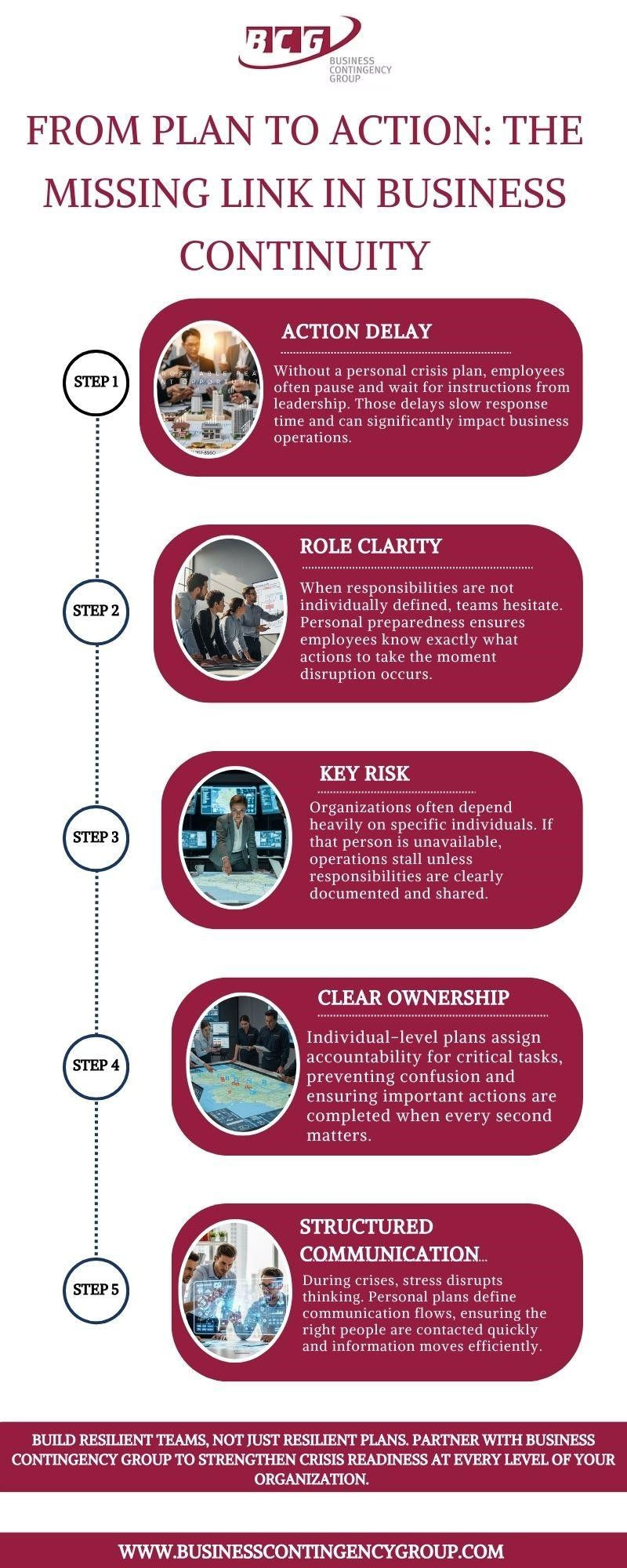
A business continuity plan is designed to keep essential operations running through and after a disruption. But even a well-written BCP has a vulnerability- it will fall short if the people responsible for executing it do not have their own individual plans.
Here is where things break down without individual-level preparedness-
People wait instead of acting- Without a personal plan, employees look up the chain for instructions. That delay costs time the business simply cannot afford.
Key-person dependency becomes a real problem- If one person is unavailable and no one else knows their responsibilities, operations stall. A documented individual plan removes that risk.
Accountability gets blurry- When everyone is responsible, no one is. Individual plans assign clear ownership so critical tasks do not fall through the cracks.
Communication breaks down fast- Stress and urgency do not bring out structured thinking. Individual plans define who contacts whom- keeping communication from turning into chaos.
Did You Know? According to FEMA, nearly 40% of small businesses never reopen following a major disaster- largely due to the absence of structured, role-level crisis response within their continuity planning.
How Individual Plans Strengthen Business Continuity Strategies?
The best business continuity strategies do not live only at the executive level- they run through every layer of the organization. Leadership can design the most thoughtful continuity framework, but if the people carrying it out lack individual direction, that framework will struggle when it is actually needed.
Here is what individual plans bring to the table-
They turn broad continuity goals into specific, actionable steps for each role
They allow departments to respond simultaneously rather than waiting on a single chain of command
They reveal weaknesses in the overall strategy when tested and reviewed regularly
They give employees the confidence to act without checking in at every step
There is also a benefit that often goes unnoticed- when individual plans are updated consistently, they feed real insight back into the broader strategy. The gaps you find during a review are exactly the gaps that could cost you during an actual crisis.

Step-by-Step- Building an Individual Crisis Management Plan
Here is a straightforward approach to get started-
Step 1- Identify Risks Specific to Your Role- Think about what could go wrong in your specific function- data loss, staffing gaps, system outages, vendor failures. Get specific rather than general.
Step 2- Define What Cannot Stop- Every role has functions critical to business operations. Identify yours and rank them by urgency and impact. These are what your plan needs to protect first.
Step 3- Name a Backup & Prepare Them- Designate someone who can take over your responsibilities if you are unavailable. The key is to make sure they are genuinely trained and ready, not just listed on a form.
Step 4- Document Your Communication Chain- Who do you report to? Who reports to you? What are the backup contact methods if primary channels fail? Write it down clearly.
Step 5- Connect it to the Company's Business Continuity Plan- An individual plan operating in isolation is a missed opportunity. It must align directly with the organization's broader business continuity plan to deliver real value.
Step 6- Test & Improve It- Run through disruption scenarios at least once a year. A plan that has never been tested has never truly been proven. Use what you learn to sharpen it.
Key Takeaways
Individual Plans Enable Collective Resilience- When every person has a defined crisis role, the organization responds faster and with far less confusion.
Alignment with the Continuity Plan Is Essential- Individual plans are most powerful when they directly support the broader business continuity plan- not when they exist in isolation.
Clear Ownership Protects Operations- Specific responsibilities ensure that when pressure peaks, nothing critical gets dropped.
Untested Plans Are Unproven Plans- Reviewing and simulating individual plans regularly is what turns a document into a real tool.
Crisis Readiness Is a Culture- Organizations that build preparedness into every role- not just leadership- come out stronger on the other side.

Final Words
A crisis management framework is only as strong as the individuals within it. Broad organizational plans set the direction, but it is the role-specific, individual-level plans that determine whether that direction is actually followed when disruption hits. Investing in those individual plans is not a nice-to-have- it is what gives your entire business continuity strategy its backbone.
If you are looking to create a continuity framework for your organization that works at every level, check out Business Contingency Group for more guidance from experts with more than two decades of experience.
FAQs on Crisis Management
1. What is the difference between a crisis management plan and a business continuity plan?
A crisis management plan focuses on immediate response- what you do in the first hours of a disruption to contain the situation. A business continuity plan looks further ahead at how core operations continue and recover. They are most effective when used together.
2. Why do individual plans matter for small businesses?
In a small business, every person carries real operational weight. One person without a clear plan can create a ripple effect across the entire team. Individual plans ensure that even lean teams can respond effectively and keep downtime to a minimum.
3. How often should individual crisis management plans be reviewed?
At least once a year. Any meaningful change- a new role, updated technology, or a shift in business priorities- should also trigger a review.
4. Can a standard template work across the whole organization?
Standardizing the format makes adoption easier, but the content must reflect each specific role. A generic plan will not hold up when a real situation unfolds.
5. Where should someone start when building their first individual plan?
Start by identifying the risks specific to your role. Once you understand what could realistically go wrong in your area, defining critical functions, naming a backup, and mapping your communication chain becomes far more manageable.


Comments