
Crisis Management Consultant Guide: Effective Plans, Risk Management and Business Continuity Strategies

No business schedules a crisis. But the ones that come out on the other side intact? They scheduled their response to one. A cyberattack, a sudden vendor collapse, a reputational issue that explodes on social media- these situations do not send a warning. And the difference between a business that absorbs the blow and one that folds under it almost always traces back to one thing: how prepared they were before it happened. That is exactly where a crisis management consultant earns their place.
Most businesses only start thinking about crisis response after something has already gone sideways. That is the wrong starting point. In this blog, we will break down what makes crisis management plans actually hold up under pressure, how risk management and business continuity work together in practice, and the strategies that give businesses a real shot at recovery when things go wrong.
What Does a Crisis Management Consultant Actually Do?
A crisis management consultant is not the person you call when the building is already on fire. They are the person who walks through the building beforehand, spots every fire hazard, and makes sure the sprinklers are actually connected.
Their work tends to cover-
In-depth risk assessments across departments, systems, and external dependencies
Building crisis management plans that reflect the specific realities of the business- not a one-size-fits-all template
Getting leadership teams to actually understand and own their roles, not just read a document
Building communication structures that work when everything else is under pressure
Revisiting and updating plans after real incidents, drills, or changes in the business
The thing is- a lot of organizations treat crisis planning like a box to check. Something to have on file, not something to use. That mindset is where vulnerability takes root.
What Should a Crisis Management Plan Include?
A crisis management plan that does not speak to the specific risks of your business is not really a plan. It is a template. And templates do not hold up when things get real.
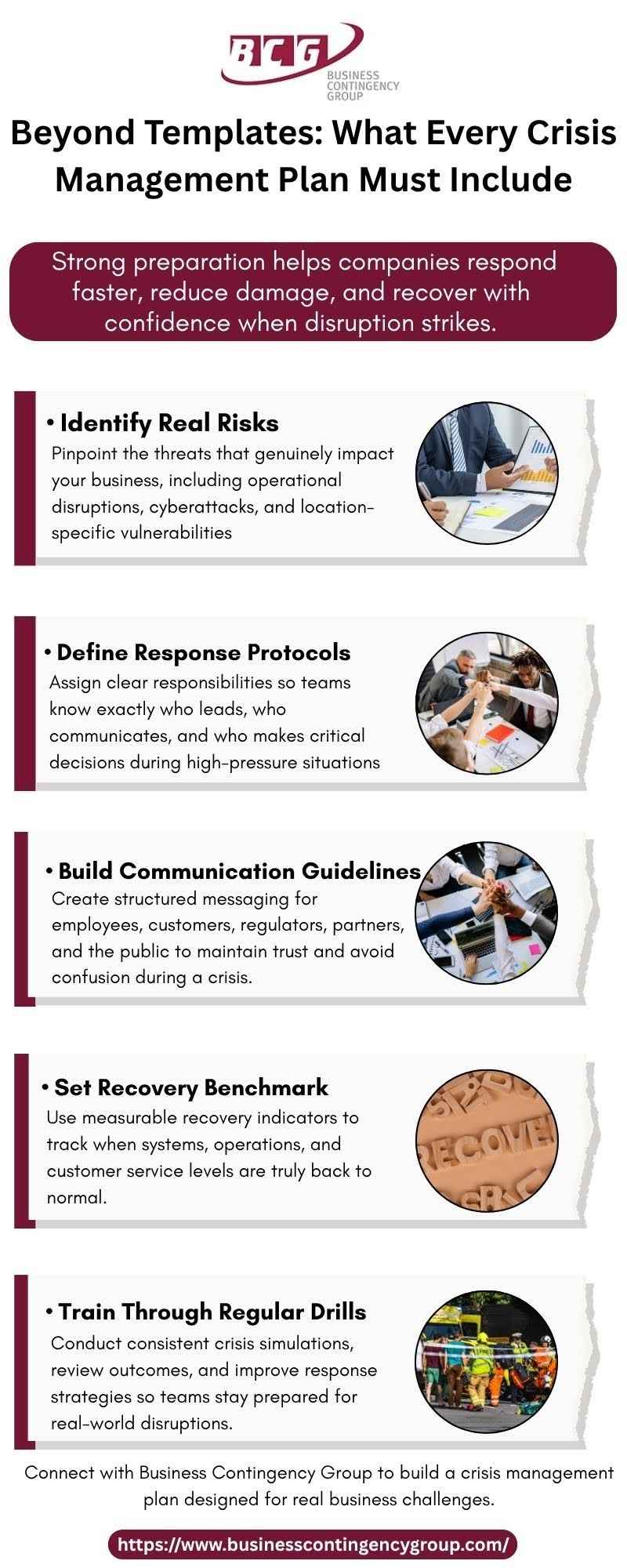
A plan that actually works needs-
Risk identification- The real threats. Not theoretical ones. The vulnerabilities tied to your industry, your operations, your people, and your geography
Response protocols- Clear ownership. Who does what, in what order, and who has the authority to make calls when time is short.
Communication guidelines- How leadership talks to internal teams, and how the business speaks to clients, regulators, and the public.
Recovery benchmarks- Specific, measurable indicators that tell you when operations are genuinely back to normal.
Training & drills- Not an annual checkbox. Regularly scheduled, properly documented, and actually reviewed afterward.
Did You Know? Organizations with a documented crisis plan in place recover from disruptions significantly faster than those without one- making crisis preparedness one of the smartest operational investments a business can make.
How Does Risk Management and Business Continuity Protect a Business?

These two get paired together constantly- and that is because they genuinely belong together.
Risk management is about being clear-eyed about what could go wrong and doing the work to reduce those odds. Business continuity planning is about accepting that some things will go wrong anyway and making sure the critical parts of the business keep running when they do.
Between the two, a business is protecting-
Revenue and cash flow that would otherwise stall during downtime
The client trust that takes years to build and seconds to damage
Regulatory and compliance standing that cannot slip even during a disruption
The day-to-day stability that employees and operations depend on
Why is business continuity planning important during a crisis? Because going offline- even briefly- can have consequences that outlast the disruption itself. Businesses with real continuity plans do not just survive crises. They come out of them with their reputation intact.
Step-by-Step: How to Build a Crisis Management Strategy
A crisis management strategy is built intentionally. It does not emerge from good intentions alone- it takes structured effort and honest input from the people closest to each operational area-
Step 1- Map the Real Risks
Start with what is actually likely- operational failures, financial exposure, reputational threats, supply chain gaps. Keep it grounded.
Step 2- Rank by Impact & Probability
Not every risk deserves equal energy. Prioritize based on what would hurt the most if it happened.
Step 3- Assign Ownership with No Grey Areas
Everyone on the response team needs to know exactly what they are responsible for. Confusion in a crisis costs time the business does not have.
Step 4- Write Scenario-specific Playbooks
Different crises need different responses. Build guides that are detailed enough to be followed under pressure, not just referenced.
Step 5- Test - and Test Again
Drills, tabletop exercises and walkthroughs again. A plan that has never been tested has never actually proven itself.
Step 6- Build in a Review Cycle
How often should crisis management plans be updated? Every quarter at a minimum. And immediately after any meaningful change in operations, staffing, or regulatory environment.
How to Ensure Compliance with Crisis Management Plan?
Getting a plan written is the starting point- not the finish line. The harder part is making sure it is actively followed, audited, and updated as the business evolves.
What that looks like in practice-
Assign a specific person or team to own crisis plan compliance- not a committee that never meets
Schedule quarterly reviews and keep a paper trail of every session
Document all training, drills, and post-incident debriefs
Cross-check the plan against current industry regulations and update when those regulations shift
Review contact lists, escalation paths, and communication channels on a consistent cycle
Crisis Management Tips for Entrepreneurs
Running a smaller operation comes with a narrower margin for error. Resources are tighter, teams are leaner, and a single disruption can hit much harder than it would at a larger organization.
These crisis management tips for entrepreneurs are worth taking seriously before the pressure arrives-
Start Simple- A focused, one-page risk summary with clear next steps beats a lengthy document that sits unread.
Identify Your Single Points of Failure- What breaks if your top client walks, your primary supplier closes, or your systems go down for 48 hours?
Set Up Your Communication Chain Now- When a crisis hits, people need to know exactly who to contact and how- without having to figure it out under stress.
Keep a Financial Buffer- Three to six months of operating expenses in reserve can be the difference between recovery and closure.
Bring in an Outside Perspective - A crisis management consultant sees the blind spots that internal teams miss- simply because they are not too close to the operation to notice them.
Key Takeaways
A crisis management consultant builds organizational resilience long before a disruption ever occurs.
Solid crisis management plans are specific to the business, tested regularly, and treated as working documents- not static files.
Risk management and business continuity complement each other to protect operations, revenue, and long-term reputation.
A crisis management strategy only works in practice if it has been rehearsed and refined through actual drills.
Entrepreneurs who plan early- and get professional input- are far better positioned to protect what they have built.

Final Words
The businesses that come through a crisis intact are not lucky. They are prepared. From building crisis management plans that actually reflect real-world risk to executing a rehearsed crisis management strategy when it counts, the work done before disruption defines everything that happens after it. A seasoned crisis management consultant brings the structure, the experience, and the outside perspective that most organizations cannot build on their own.
At Business Contingency Group, we help businesses across industries develop continuity frameworks that are practical, compliance-aligned, and built around the specific risks that matter to them.
Ready to protect what you have worked to build? Reach out to Business Contingency Group today and start building real resilience.
FAQs
Q What should a crisis management plan include?
Risk identification, clear response roles, communication protocols, measurable recovery benchmarks, and scheduled, documented drills.
Q How does risk management and business continuity protect a business?
Risk management reduces the likelihood of disruption. Business continuity ensures operations keep running when disruption happens anyway.
Q How often should crisis management plans be updated?
Every quarter at a minimum- and right away after any significant operational, regulatory, or staffing change.
Q What are the top crisis management tips for entrepreneurs?
Start with a simple risk document, identify failure points, build a communication chain, maintain a financial buffer, and bring in outside expertise.
Q Why is business continuity planning important during a crisis?
It keeps essential functions running, limits financial damage, and protects the client relationships and reputation that the business depends on.


Comments